Tran Ngoc Anh’s youth has been shaped almost entirely by a computer screen. For a girl who, since childhood, could never stand or walk unassisted, the computer began simply as a tool for learning and for connecting with the world outside. In time, that same computer would help Anh find a suitable career, earn an income, and gradually build a life of her own — and later, open doors of opportunity for many other people with disabilities.
Twenty-One Closed Doors
Born in 1995 in Hung Yen province, Anh came into the world weighing barely one kilogram. Her development lagged far behind that of other children her age. Spastic cerebral palsy severely impaired her motor function, and her childhood revolved around physical therapy, acupuncture, and endless exercises; her rigid, contracted legs made even the simplest movement an ordeal.
Anh started school later than her peers. While other children ran and played in the yard, she could only sit in the classroom. Unable to join in her friends’ games, she buried herself in books instead. Learning became her way of opening up a world that her legs could not carry her to.
Being different also meant Anh repeatedly heard words that wounded her. Some people asked what the point of her studying was, since she would end up depending on her family for the rest of her life anyway.
But Anh’s parents saw things differently. They refused to keep their daughter shut away simply because she was frail. They were determined to send her to school, to let her engage with society, learn to communicate, and — most important of all — learn a trade that would let her support herself later in life.
Anh grew up carrying that same resolve. She wanted to prove that she could accomplish something through her own ability, rather than spend her whole life as a burden on her family and society.
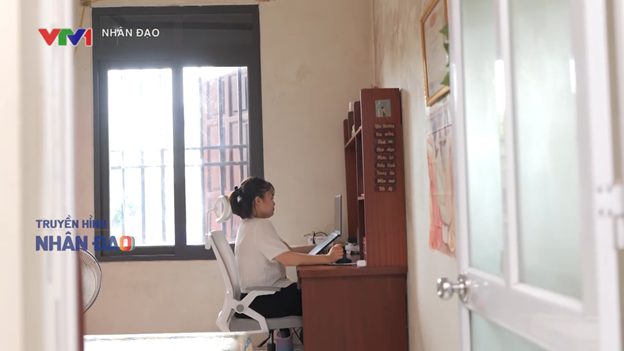
In 2016, Anh began looking for work. That was also when she realized just how wide the gap could be between the desire for independence and finding a job genuinely suited to someone with a disability like hers.
She remembers clearly being turned down 21 times. For many people, that many failures might be enough to shake their confidence to the core. But Anh instead asked herself: “If I can’t meet a job’s requirements in the usual way, might there be another way of working that suits me better?”
Anh began teaching herself. Starting with content creation, she dug deeper into Google, Google Maps, websites, and how to find customers for businesses. Online marketing gradually opened up a new path for her.
In the digital realm, physical mobility was no longer the main obstacle. Instead, knowledge, skill, and the ability to create value became what mattered. The computer that had once been the companion helping a girl who couldn’t run and play with her friends open a door to the world now became the tool that helped Anh step into the labor market.
She found work that suited her. But the job search also led Anh to a realization: she was likely not the only one standing before a door she didn’t yet know how to open.
From Seeking Opportunity to Creating It
Anh understood the feeling of having ability but not knowing where to find opportunity. She also understood that, for many people with disabilities, the difficulty isn’t only whether a company is willing to hire them. Often, the harder part is finding a trade that fits their abilities, their health, and the way they live.
The digital environment, meanwhile, offered another way forward. People with disabilities could learn skills, find clients, and carry out their work from home, reducing the barriers posed by mobility and the physical workplace.
Drawing on her own experience, Anh began thinking about passing that opportunity on to people like herself. In 2022, she launched free online-marketing classes for people with disabilities across the country.
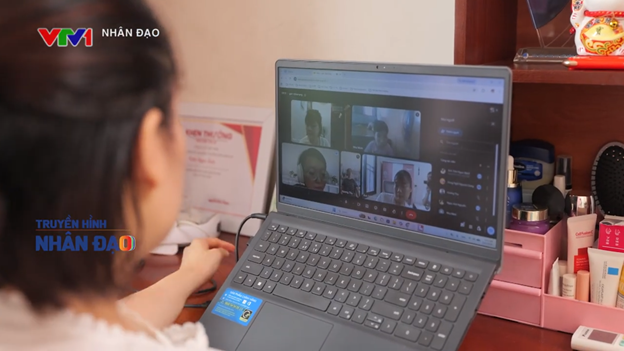
She taught others what she had once had to figure out on her own: how to find clients, take orders, and carry out the work. But Anh didn’t want the training to stop at a course or a certificate. She understood all too well that, for someone striving to become independent, a certificate is no substitute for an actual job.
So after training, those who were a good fit were hired by Anh herself or connected with job opportunities. From there, the classes became more than a place to learn a trade — they became a starting point for people with disabilities to step into real work.
By 2024, Anh had founded Gucomedia, bringing together people with disabilities doing online-marketing work across many provinces. They work remotely, coordinating with one another through digital platforms, and earn income from the work they themselves carry out.
What Anh wants to change isn’t the expectation that people with disabilities must strive to become “like everyone else.” She wants to prove that work itself can be organized in different ways to fit each person’s abilities. With the right job, people with disabilities can generate income, provide for their families, and take greater control of their own lives.
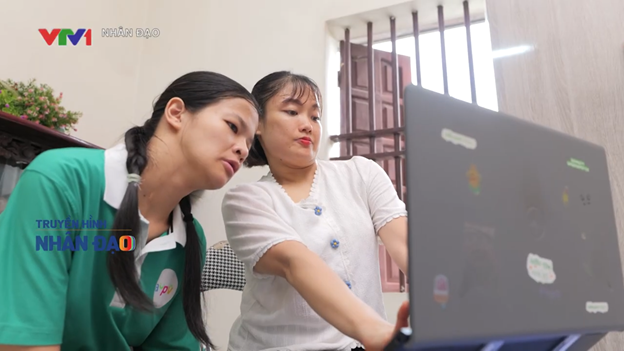
When her trainees earn their first money through their own ability, what they gain is more than an income. It’s the feeling of being useful, of being capable, and of having the right to choose their own life. No one understands that value better than Anh. The door she once searched for is now the one she is working to open for others.
Not Just a Job, but a Place to Belong
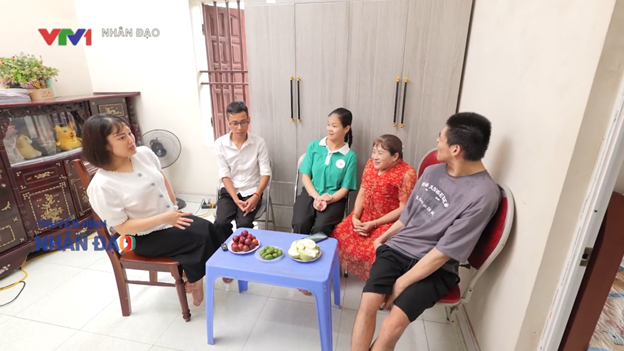
The more time Anh spent alongside people with disabilities, the more she realized that employment addressed only part of what weighed on them. Many still spend most of their time at home. What they lack isn’t only a job, but also encounters, relationships, and a community in which to share things that are hard to say to someone who hasn’t lived through the same circumstances.
So Anh set off on a new journey. She founded the Hung Yen Club for Adults Living With Cerebral Palsy and took on the role of club chair. There, people in similar circumstances can meet, share, offer each other guidance, and connect.
Anh doesn’t want the club to be a place people turn to only when they need help. She’s aiming for a community where everyone can find information, learn, build relationships, and gradually take more initiative in their own lives. Further ahead, she hopes to add more vocational-training activities — from marketing to handicrafts — so that each person has more options suited to their own abilities.
If Anh once needed someone to show her a path, she is now trying to become that guide for others. From someone who needed an opportunity given to her, Anh has become someone who gives it.
Bridges That Keep Compassion Flowing
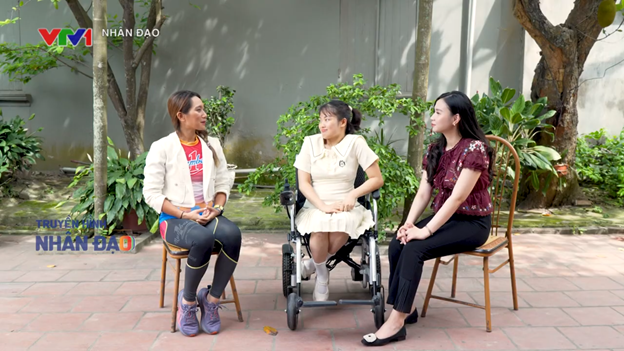
Finding and sharing the stories of people like Tran Ngoc Anh is also the mission of Noi Tron Yeu Thuong (Vietnamese for roughly “Love, Fully Connected”).
For more than seven years, the program — produced by the team at the Humanitarian Television Channel and accompanied by Tan Hiep Phat Group since its earliest days — has traveled across the country to find, meet, and tell the stories of ordinary people with extraordinary resilience: people who rise above their circumstances, live responsibly, live for others, and live larger than themselves.
Hundreds of subjects mean hundreds of different stories: some facing illness, some overcoming loss, some living with disabilities since birth. But what the program looks for isn’t adversity itself — it’s how each person chooses to overcome it and go on living afterward.
Someone who overcomes hardship for their own sake is already admirable. But someone who, having found their footing, then chooses to live responsibly, to lift others up, and to turn their own experience into motivation and opportunity for the community — that story moves us far more deeply.
That’s also why the stories told by Noi Tron Yeu Thuong don’t stop at making viewers feel sympathy. They stir a belief that adversity need not be an ending; sometimes, it can become the beginning of a new journey.
Along the way, Tan Hiep Phat has contributed more than just the resources to help these stories be told. The company sees in Noi Tron Yeu Thuong a genuine alignment of values. The program inspires a spirit of perseverance, optimism, resilience, and the courage to face life’s challenges. Its subjects choose not to live only for themselves; from what they have been through, they go on creating value for their families, their communities, and society.
These are also the values Tan Hiep Phat cherishes and pursues. For the company, when kindness and resilience go hand in hand, positive value can be created and multiplied. One person who overcomes their own limits can inspire another. One opportunity given away can become many more opportunities. One beautiful story, once told, can go on creating more beautiful stories.
Tran Ngoc Anh cannot change what happened to her. She cannot make it as though the 21 rejections never occurred. But she can choose what she does after all of it — and she has chosen to keep moving forward. Not just forward for herself, but forward while opening more doors for the people standing where she once stood.
This, too, is the meaning of Noi Tron Yeu Thuong. A program can begin with a single meeting. A story can begin from a single hardship. An act of sharing can begin with a single outstretched hand. And when those things keep being passed on, the story no longer belongs to just one person.
From one door opened for Anh, more doors are being opened for many other people with disabilities. From one story told, more stories continue to be written.
And from one meeting, the bridges of love keep stretching onward.
Source: https://cafef.vn/tung-21-lan-bi-tu-choi-khi-xin-viec-co-gai-bai-nao-bien-chiec-may-tinh-thanh-canh-cua-viec-lam-cho-nguoi-khuyet-tat-188260915214428544.chn